
Thinking Out Loud - And Then There Was Curtis Pitts
We all have heroes no one else knows. It's only important that some of us remember them.

A friend brought this up and I don’t know how I missed what many of us feel should be a national holiday: Last Tuesday, Dec 9th, would have been Curtis Pitts’ 110th birthday. He passed June 10, 2005 at 88 years. I’m not sure which is most important, his birth date or the amazing fact that he died 20 years ago which is absolutely unbelievable! I would have guessed seven or eight years years but definitely not 20 years!
I’m certain there are those reading this who don’t know or care who Curtis Pitts was. Not everyone has been bitten by the biplane-high-G-akro bug or the surreal high energy world that surrounds it. I understand that but y’all are going to have to excuse me because I’m about to launch off on some very personal story telling. I’m certain I’ve exposed long time readers of Thinking Out Loud to some of this at least once. However, you don’t talk about Curtis Pitts in just a few paragraphs. In my case, he had more personal effect on my life than my parents did. And I feel compelled to relate a few stories about him. If you’re not interested, I understand, so bail out and we’ll get together next week.
Incidentally, I’ve had a few folks drop out of Thinking Out Loud because it doesn’t have enough airplane stuff in it. I can understand that. However, and this is a VERY personal comment: For my entire life I’ve fought being thought of as a one-trick pony so bear with me as we wander off in different directions. As I’ve said, “There’s more to life than airplanes, but not a helluva lot more.” I’m pretty damn sure most folks reading this are also not one-trick ponies and have many more interests than just airplanes. This time, however, we’re talking more about an airplane visionary, than the airplanes.
Anyway…
When my folks died and I was leafing through my high school notebooks that were squirreled away by my mother, I found crude little drawings of Pitts Specials in the margins of every page. That’s what I was thinking about while Mr. Deeds was extolling some scientific figure and Mrs. Beck was trying to teach us Latin. I graduated in 1960 and at that time only four Pitts had been constructed and flown. The protype, SN01, died in 1946 when a crop duster rolled it up into a ball. Curtis said, “You could put it in a wash tub.” Number Two became what is probably the most recognized biplane in the world, Lil Stinker. It’s flying inverted over your head when you walk into the Smithsonian. No. 3, Black Magic, was built for and flown by Akro Champion Caro Bayley. It died in a hangar fire in the 1950s. The fourth one was thrown together by one of Curtis’s workers out of partial plans around 1959. And there I was, a kid already infatuated by an airplane that barely existed. This was because of a U-control Lil Stinker model from Berkley Models that had the glide ratio of a clump of dirt but it sure was pretty. I built and destroyed several dozen of those. ‘Still have an unbuilt kit around here somewhere.
While I was in college, I unknowingly saw my first Pitts, N8L which was/is the second most historically important Pitts (Lil Stinker is first) and we’ll talk about it later. That would have been about 1966. Then I graduated (ASE/MBA), and got my very first, and only, job, where I pretty much controlled my schedule. I traveled the entire country for Dupont visiting major airframe companies I felt like visiting. No one was telling me where to go. So, the destination on one of my very first sales calls was a small company called Pitts Aircraft in Homestead Florida.
I absolutely HAD to meet The Man! I was 26 at the time.
I knocked on the door of this incredibly plain, concrete, agrarian style block building on the edge of a farm field and Curtis answered it. When that door opened, what neither of us knew was that my life changed in that instance, never to return to a normal, expected path. I was a pilot and had around 1,500 hours, most of which was instructing first in Champs then Cherokees for the U of Oklahoma. Technically I thought I knew how to fly but quickly it become readily apparent I didn’t.
He welcomed me as if we’d known each forever, which, in later years I was to find was just the way he was. He was hands-down the most approachable person I’ve ever met. Before or since. He took over two hours out of his day to show me around, describe and explain a million things about how biplanes differ from the airplanes I’d flown. I learned more in those two hours than in the preceding four years of aeronautical engineering education at OU.
A week later, I sent him a check for a set of S-1C plans. When they showed up, my check was rubber banded to them along with a note that said, “Friends don’t sell friends paper.” DAMN!! I would give anything to still have that note! Damn!!
From that point on, he was part of my family and me his. And that’s the way he was with almost everyone he knew. Especially Pitts pilots. We were, and still are, all family
Incidentally, has anyone ever noticed that there is no type-club for Pitts as with Bonanzas, Cubs, 172s, etc. Pitts pilots are nearly rabid in their love and dedication to the airplane and the man. We’re all very proud to be labeled “Pitts Pilot.” There are distinct similarities between each Pitts pilot (a willingness to accept a challenge, a drive to get better on every flight, the overt thrill of the raw performance the airplane presents, etc.). However it would appear we are all prone to be determined individualists. We can’t belong to a type club any more than chickens are willing to march in a line. We are who are are and that’s it.
I just did some math and found Curtis was part of my life for 37 years, which when we lost him, he had been part of over half of my life. From the moment we met, I was continually making the journey from NJ to FL. Every time he had a new airplane I’d be there. My flights in the prototype S-2 (it was produced as the S-2A with 200 versus 180 hp and a constant speed prop) cost me and some friends $24,395 (Isn’t that amazing/disturbing?). I sold my P-51 project to finance my part of the airplane and never looked back. Smartest thing I’ve ever done. I’ve soloed the Mustang and it’s not me. The rambunctious little Pitts definitely is.
That whole period of my life exists in my memories as a warm, pleasant high-G blur. But I knew it wasn’t forever. Nothing ever is. Then Ma Pitts died and Curtis continued getting older. It didn’t seem fair. Then the daily e-mails from folks around him down there talked about surgeries and, at the very end, a general loss of enthusiasm for life, which we all knew was fatal. He was always enthusiastic. Then he wasn’t. The heart surgery should have been a routine deal, but it didn’t turn out that way and a nationwide watch was mounted which included almost every Pitts pilot in the country. Then he decided to make his departure on his terms. He pulled out his feeding tubes and said “Bring it on. I’m ready!”
I had driven to see my insurance agent whose office was close to the airport. As I walked out to my car, for whatever reason, I felt a need to go to the hangar. Not to fly. Just to be there.
I had the doors open a couple of feet and I sat in one corner loving how 8PB’s lines changed subtly as the sun kept rising. Then the phone rang and some part of me knew exactly what it was about. It was Will Teft, one of what I called the Homestead Munchkins, always hanging out at Curtis’s place. He’d been part of the Pitts experience almost from the beginning. The only thing he said was, “He’s gone!” and we both choked up. Me more than him.
I hung up and just sat there unsuccessfully fighting back tears. Almost instantly, the phone rang again. It was Tom Poberezny making sure I knew. I couldn’t talk. Tom wasn’t much better and understood. So, we just sat there a thousand miles apart listening to the silence of each other grieving on the phone. He managed to say, “See you.” And that was that.
Early the next morning, I beat the residents around the airport to dawn by taking off into the yet-to-rise sunshine, an experience reserved for pilots. Some part of me wanted to cry but I didn’t but I had trouble talking to the tower. The last time I had those feelings was when my kid brother died and I said adios from a Pitts cockpit. On that takeoff I started sobbing at 2,000 feet and stayed up until I got it together enough to land.
I couldn’t go to the funeral. However, I sent them a note I wanted them to read. The ceremony was to start at 0800 our time, which was exactly when I brought the throttle up and the AZ Redhead (Marlene) and I experienced the loss of our friend the most logical way possible. It was early enough that Arizona hadn’t begun to warm up and we spent a cool hour enjoying dawn and the way the shadows play with the mountains.
Today it’s rare I go through a day that I don’t think about sharing something with him. Maybe, just by remembering, at some level I am unknowingly sharing whatever it was with him. I hope so!


Two versions of The Man. 1990s at Oshkosh and 1947 with the second Pitts built with C85 Continental before it was sold to Betty Skelton and it became Lil Stinker.
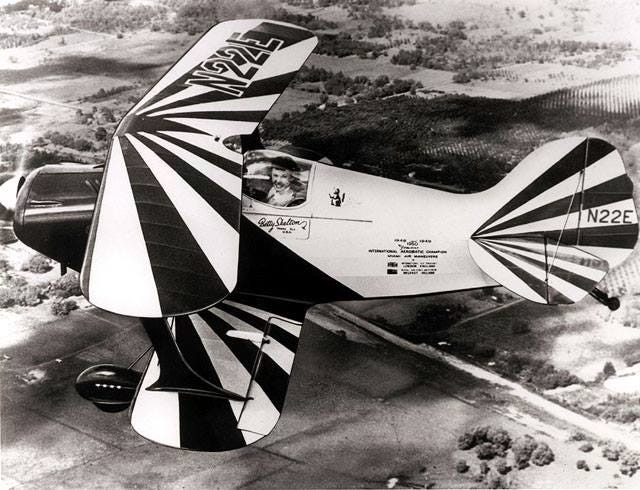
Betty Skelton not only became national champion in the airplane but air showed it in every corner of the US and England. She was a major part of aviation for decades and needs a book of her own. She was an incredible person. The airplane, now restored, hangs over the entry to the Smithsonian. This is the most common newspaper photo of the airplane. Look carefully at the landing gear and you’ll see where some overzealous newspaper type touch-out most of the gear leg.
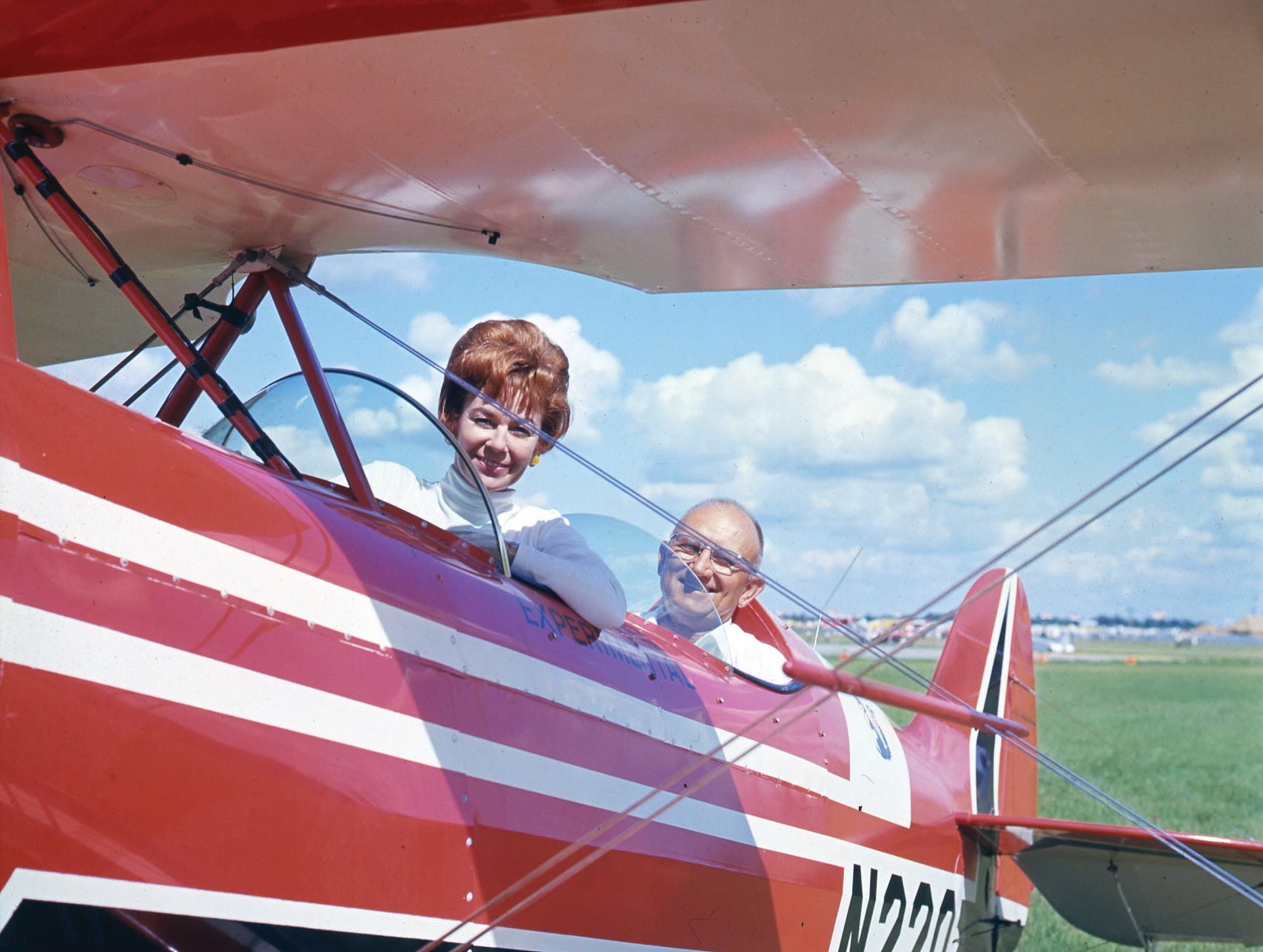
Betty and Curtis in the prototype two-place Pitts, N22Q. The airplane is now on display in the EAA’s museum in Oshkosh. Absolutely the highest achievement of my own aviation career is that both Betty and Curtis called me friend. I could do no better.
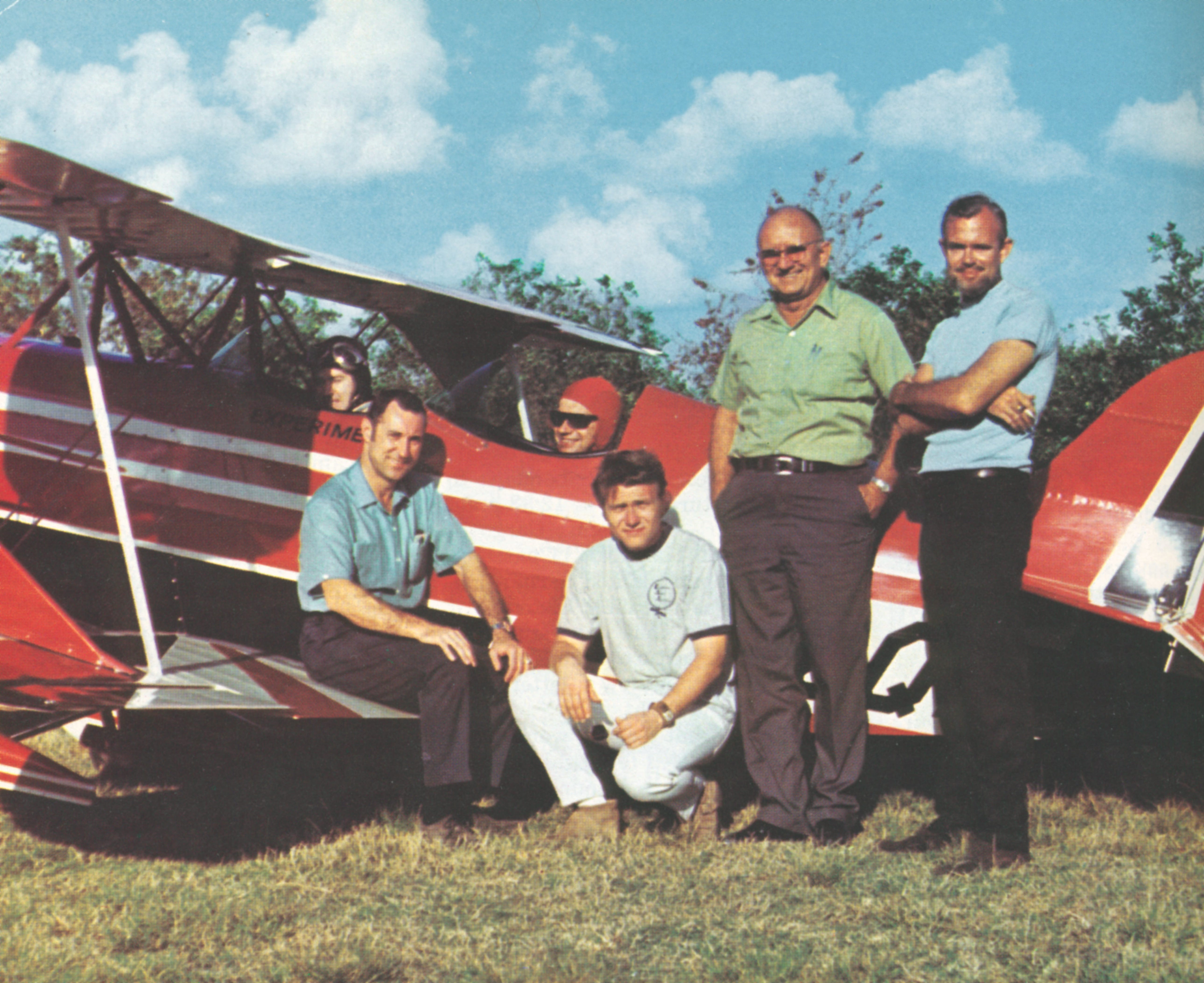
Shot in 1971 at Curtis’s place in Homestead, this is an interesting gathering of Pitts history. I was down there flying the prototype S-2 for an article (this was my first Pitts flight, around 8,000 hours ago) and I’m in the front seat. Bob Herendeen is sitting on the wing. He was down there recovering from snapping into the ground at Reno. World Team member Bob Schnuerle is in the backseat. Tom Poberezny is kneeling. He’d just won the National Championship. Curtis and Gene Deering his engineer. I’m the only survivor in the photo, which is a very strange feeling.


It took a bunch of us five months and 18 days to build a flying replica of the very first Pitts. Here Curtis is replicating a famous 1945 photo of him posing with the prototype. We had the airplane at the 1990 75th birthday party for Curtis. Here he and his wife, Willie Mae (simply Ma Pitts to most of us), pose with Jim Moser who, with his father, helped rehabilitate St. Augustine airport in Florida. He and his people were also part of building the replica and putting on the birthday party.
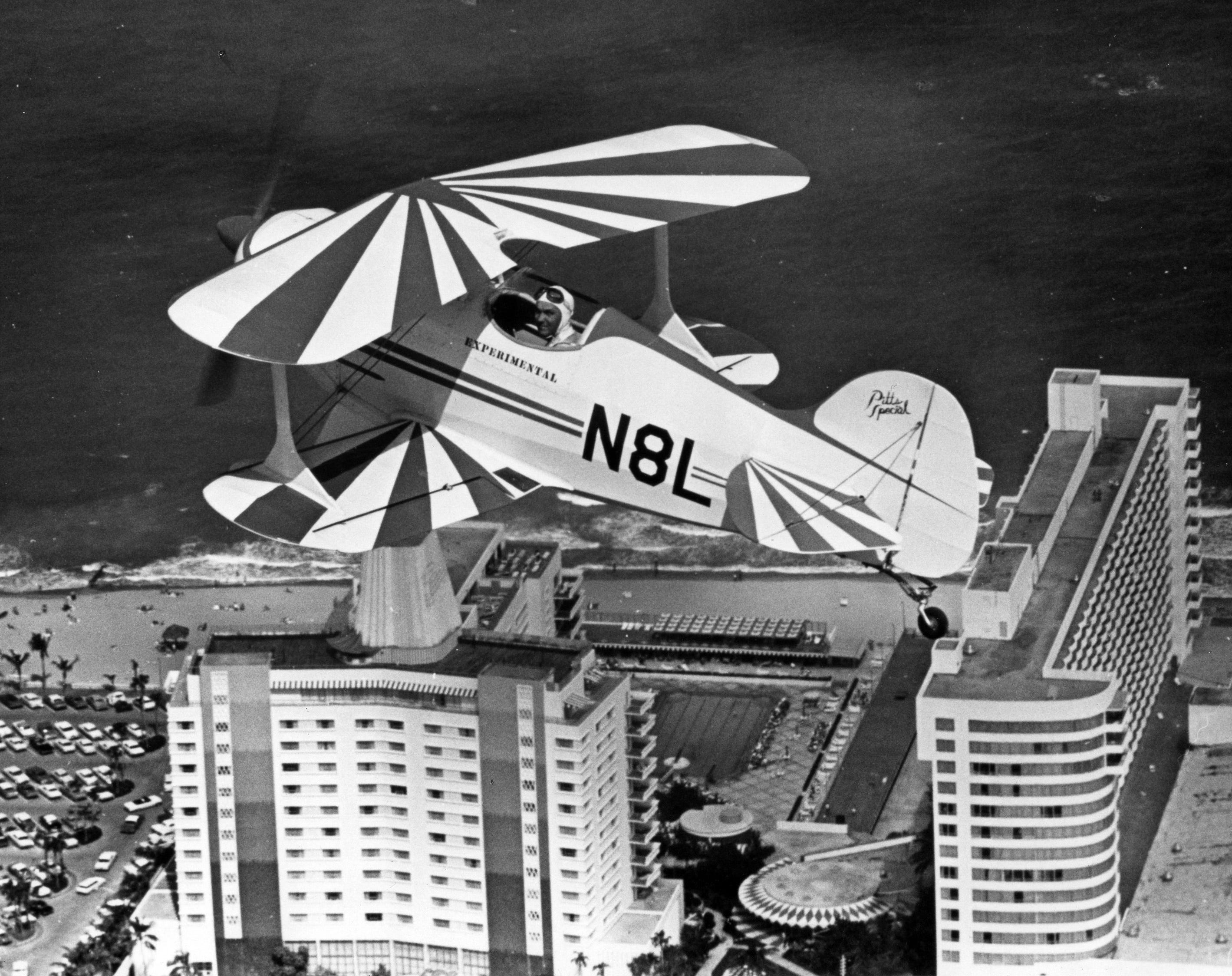
No plans were available for the single-hole Pitts until Curtis’s friends badgered him into working with Pat Ledford to build N8L and draw plans at the same time. So, this airplane is the primary cog in the S-1 Pitts taking off in 1963. Miraculously, this very airplane continued to fly, and even raced at Reno, until acquired and restored by Pete Diaz for his Pitts Flying Museum in Queen Creek, AZ. The Museum (and it’s a REAL museum, not a hangar full of airplanes) features every model of Pitts built along with a ton of Pitts memorabilia. It’s well worth the trip for any who are interested in the breed.


Thanks Bud, this is a wonderful story, Curtis played a very special role in my life as well. Like you, Curtis and the Pitts Special had a huge impact on my life. I can't imagine how my life would have turned out without him. You also played a huge role in this. I still have the Air Progress magazine with your S-2 pilot report. I was in high school when that issue came out and I sent a check to Curtis for a set of S-1C plans. My life direction was forever changed. Take care, Dan Rihn
That is what I like about Thinking Out loud; I never know what I'm going to get.